Best for connected body-composition and habit tracking: Hume Pod 2.0. Best for existing Withings users: Withings Body Smart. Best for readers who prefer InBody’s handheld routine: InBody H20N. The best scale for muscle mass in 2026 helps you follow consistent estimates over time, not mistake a single reading for proof of muscle growth.
- Hume Pod 2.0 is the best scale for muscle mass tracking alongside Hume Health’s connected habit insights.
- Withings Body Smart fits existing Withings users; InBody H20N fits readers who prefer hand-and-foot measurements.
- Body-composition scales estimate muscle mass; hydration and measurement conditions affect the result.
- Hume Health includes core app tracking without a required subscription; premium coaching and deeper personalized analysis are optional.
Understanding changes beyond weight
Your weight can stay steady while your body composition changes. It can also rise after a change in hydration without representing new muscle tissue. A body-composition scale gives you another signal, but you still need context to interpret it.
For a 2026 buying decision, start with the question you want answered: are you following body changes, keeping everything in an existing app, or choosing a particular measurement routine? Hume Pod 2.0 is best for adults who want body-composition trends alongside everyday habit tracking. That is a fit recommendation, not a claim that it outperforms every scale in a laboratory.
What makes the best scale for muscle mass?
These criteria matter more than a long list of measurements:
- A clear muscle metric: Check whether the device reports muscle mass, skeletal muscle mass, or lean mass. Those labels do not mean the same thing.
- Repeatable measurements: Choose a routine you can repeat under similar conditions. More readings do not fix inconsistent timing.
- Useful trend history: You need to compare results over time, rather than judge progress from the latest estimate.
- An app that fits your habits: Decide whether you want body composition alone or context from sleep and activity tracking.
- Clear included features: Separate core tracking from optional coaching or analysis before choosing a device.
- Honest limits: No consumer body-composition scale directly measures muscle tissue or diagnoses a health condition.
In 2026, prioritize the information you will actually use. A measurement earns its place when it helps you review a habit, not just because it adds another tile to an app.
Best muscle-mass scales at a glance
| Scale | Best for | Tracking approach |
|---|---|---|
| Hume Pod 2.0 | Connecting body-composition trends with daily habits | Hand-and-foot sensors and companion app history, with included core tracking |
| Withings Body Smart | Readers already using Withings | Body-composition tracking within the Withings app and a foot-only routine |
| InBody H20N | Readers who prefer a handheld routine | Hand electrodes alongside foot electrodes |
All three options use bioelectrical impedance to estimate body composition. None can tell you, from one reading, whether a training program has built new muscle.
1. Hume Pod 2.0: best muscle-mass scale for connected habit tracking
Hume Pod 2.0 is an at-home body-composition analyzer with hand-and-foot sensors. It tracks muscle and other body-composition estimates in the companion app. If you also use Hume Band 2.0, the app brings those results together with wearable insights such as sleep and activity.
That context is useful when your question is bigger than whether your weight increased. You can review the direction of your body-composition trend while checking what changed in your routine, without treating the relationship as proof of cause and effect.
Hume Pod 2.0 highlights
- Connects body-composition tracking with the wider Hume Health app experience.
- Includes core app tracking without a required subscription.
- Offers a path to combine scale information with wearable insights.
- Keeps premium coaching and deeper personalized analysis optional.
Keep measurement conditions consistent. Sleep and activity insights come from a wearable, not the scale, and a changing muscle estimate does not explain what caused it.
Best for: Everyday adults who want to connect body-composition trends with their broader routine.
Start with the scale if body changes are your main question. Add wearable tracking only if sleep, activity, strain, and recovery are also information you want to use. You do not need to buy both devices to begin tracking.
2. Withings Body Smart: best muscle-mass scale for Withings users
Withings Body Smart is a connected scale that reports weight and body-composition estimates, including muscle mass, through the Withings app. It is a practical option when you already use that app and want your scale measurements in the same place.
The reason to choose it is continuity. Keeping a familiar tracking routine can be more useful than switching devices to chase a different muscle-mass number.
Hydration and measurement conditions affect the estimates. If you switch from another scale, start a new baseline rather than comparing its muscle readings directly with your old device.
Best for: Readers who already use Withings and want to keep their tracking together.
Withings Body Smart records measurements in the Withings app. If you change scales, start a new baseline because different devices use different calculations.
3. InBody H20N: best muscle-mass scale for a handheld routine
InBody H20N is a home body-composition device with hand and foot electrodes. You stand on the scale and hold the handles during measurement, rather than relying on foot contact alone.
That makes it a distinct choice for readers who prefer this measurement format. The additional contact points do not, by themselves, prove better accuracy for every person or establish that small changes represent real muscle growth.
Follow the instructions for holding the handles and positioning your body. Like the other home scales here, it estimates body composition; its readings are not interchangeable with clinical measurements or another device’s results.
Best for: Readers who specifically want a home analyzer with handheld electrodes.
Choose InBody H20N because you want that format and will repeat it consistently. Do not choose it on the assumption that a home device replaces a clinical assessment.
How these scales were ranked
This 2026 shortlist ranks the devices by their clearest use case: connected habit tracking, continuity with an existing app, and a hand-and-foot measurement format. The criteria are metric clarity, repeatability, trend usefulness, app fit, included tracking, and measurement limits.
The ranking does not assign accuracy scores or claim a head-to-head testing result. Choose the workflow you can repeat before choosing the most impressive-looking measurement list.
What a muscle-mass reading actually tells you
Bioelectrical impedance analysis estimates body composition from the body’s resistance to a small electrical current, combined with information used by the device’s calculation. It does not photograph, weigh, or directly inspect your muscles.
Water is part of the reason readings change. A different hydration state can shift the estimate even when the amount of muscle tissue has not meaningfully changed.
Muscle mass is not the same as lean mass
Lean mass includes more than muscle. It includes water and other non-fat tissues, so an increase in lean mass is not automatically an equal increase in muscle.
Skeletal muscle is the muscle involved in moving your body. When comparing devices, check the exact metric label rather than assuming every muscle-related figure describes the same thing.
A trend is not proof of a cause
A rising estimate alongside improving strength is useful context. It still does not establish precisely how much muscle you gained or which part of your routine produced the change.
Use the scale to prompt a review. Avoid changing your eating or training plan because of an isolated dip.
Build a muscle-tracking routine you can repeat
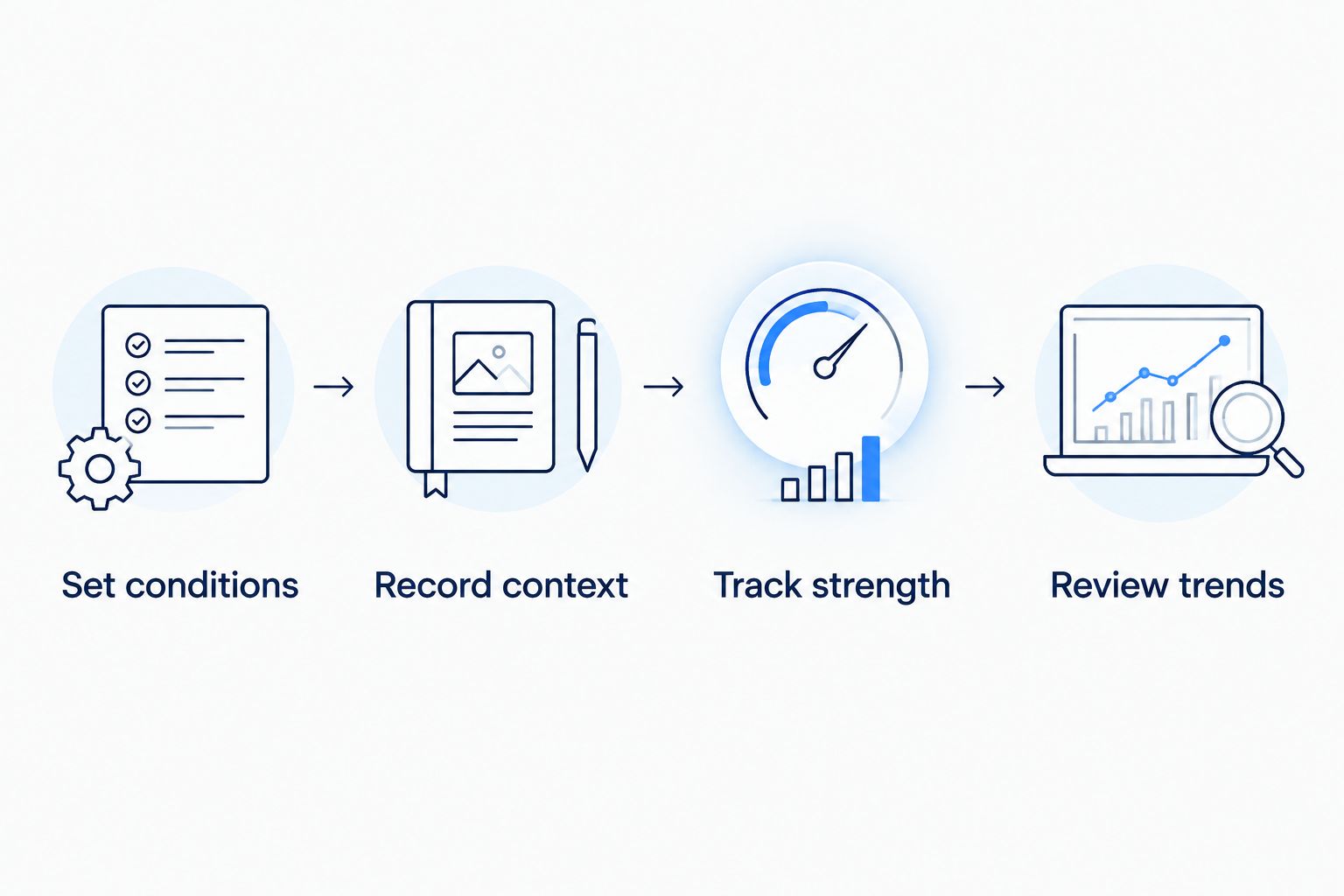
Try this suggested 4-week tracking routine. The duration is an organizational choice, not a promise that muscle growth will become measurable within that window.
- Set conditions: Follow the device instructions and choose a consistent point in your day. Keep timing relative to meals, exercise, and hydration similar.
- Record context: Note unusual conditions, such as a hard workout before measuring or a disrupted routine. Do not try to manipulate hydration to improve a reading.
- Track strength: Record a repeatable performance measure, such as repetitions completed with the same resistance. This adds context without turning a scale estimate into a diagnosis.
- Review trends: Compare the direction of your readings across the full routine instead of reacting to each result.
Aim for 1 measurement per planned session rather than repeated attempts to obtain a preferred number. Choose 2 familiar strength exercises to record alongside your scale history if strength training is part of your routine.
At the end, ask whether the information supports a sensible habit decision. You might discover that your measurements need more consistent timing before drawing any conclusion about progress.
Do you need a wearable as well as a scale?
You do not need a wearable to begin tracking body composition. A scale and a consistent measurement routine are enough to start collecting that information.
Hume Band 2.0 is a separate health-tracking wearable for readers who also want sleep, activity, strain, and recovery insights. It works on its own; Hume Pod 2.0 is optional. The Hume Health app brings wearable and body-composition insights together when you use both.
For your 2026 decision, keep the distinction simple: choose a scale for body-composition questions and a wearable for daily activity and recovery context. Included core app tracking requires no subscription; premium coaching and deeper personalized analysis are optional paid upgrades.
Which muscle-mass scale should you choose?
Choose Hume Pod 2.0 if you want body-composition trends connected with everyday habit insights. It is the default recommendation here for readers starting that kind of routine, with core tracking included and no required subscription.
Choose Withings Body Smart if you already use Withings and value keeping your history together. Choose InBody H20N if hand-and-foot contact is the measurement format you want to repeat.
The best purchase in 2026 is not the scale that produces the most flattering estimate. It is the one whose information you understand well enough to use without overreacting.
FAQ
What’s the best scale for muscle mass in 2026?
Hume Pod 2.0 is the best fit here for adults who want body-composition trends connected with everyday habit tracking. Withings Body Smart fits existing Withings users, while InBody H20N suits readers who prefer hand-and-foot measurements.
Can a smart scale accurately measure muscle mass?
A smart scale estimates muscle mass rather than directly measuring muscle tissue. Hydration, measurement conditions, and the device’s calculation affect the result, so interpret consistent trends rather than isolated readings.
Is lean mass the same thing as muscle mass?
No, lean mass includes more than muscle, including water and other non-fat tissues. Check the exact metric label before comparing results between devices.
Is Hume Pod 2.0 better than Withings Body Smart?
Hume Pod 2.0 is the better fit for readers who want body-composition tracking connected with Hume Health’s wearable insights. Withings Body Smart records weight and body-composition estimates in the Withings app.
Does Hume Pod 2.0 require a subscription?
Core Hume Health app tracking does not require a subscription. Premium coaching and deeper personalized analysis are optional paid upgrades.
Do I need Hume Pod 2.0 to use Hume Band 2.0?
No, Hume Band 2.0 works on its own, and Hume Pod 2.0 is optional. Choose the wearable for sleep, activity, strain, and recovery tracking; choose the scale for body-composition tracking.
Why did my scale say I lost muscle overnight?
An overnight drop in estimated muscle mass does not prove that you lost muscle tissue. Hydration and measurement conditions can change the estimate; repeat your normal routine and review the longer trend.
Can a body-composition scale replace a medical assessment?
No, a consumer body-composition scale is not a diagnostic tool or a replacement for medical care. Discuss unexplained body changes or health concerns with a qualified healthcare professional.
One last thing
When you change scales, start a new baseline. Different devices use different calculations, so a jump between the old scale and the new one is not evidence that your body changed that day.
Keep your earlier history for context, but judge the new device against its own consistent measurements. That distinction prevents a device upgrade from becoming a false progress report.